Last week, we rang in a new academic year here on Bateman's shores, and to celebrate, here is a little fireworks display. Well, not exactly fireworks, but the explosive seed pod of a Jewelweed plant, a.k.a. Touch Me Not. Even shot in slow motion, the ejection of the seeds from the spring-loaded pod is too quick to really capture. It is a sure sign of autumn's arrival when these plants begin firing scattershot around the woodlands and pond edges.
Pretty exciting stuff. As we settle in for classes, though, it would behoove us all to take the time to relish the quieter, less volatile sides of Estabrook and Bateman's Pond. At this time of year, as cool air masses come in over the warm waters of the pond, early risers will be treated to a misty ballet on Bateman's surface. A recent such event was captured in a time lapse video that really showed the currents swirling gently through the morning air. In real time, this phenomenon is not quite as dramatic but just as soothing.
And of course, this wouldn't be an EstaBlog post if there were no birds mentioned. Fall migration is in full swing, so unexpected species like this Olive-sided Flycatcher, on its way from Canada to South America, are stopping for a rest and a bite to eat on our campus. This individual was the first of its kind that we've spotted at Middlesex.
While it is not a terribly colorful or charismatic bird (to the casual observer), it is on an impressive and incredibly dangerous journey, so we should wish it well as it tries to avoid such predators as this young Cooper's Hawk, which was lurking nearby.
Please comment or email me with any sightings, photos, or questions that you have about nature at MX. With so many eyes and ears on the alert, we are bound to find something amazing this year!
Nesting and fledging continues around campus, with the early season breeders already feeding young while the mid-season nesters are still working on construction. A pair of Cedar Waxwings was recently observed building their nest out of oak catkins (the oaks' "flowers") in a Plane Tree between Hallowell and BP:
Both of the pair work constantly to gather the materials and weave them into the walls of the nest, finally settling in and "shimmying" to shape the cup before heading out for another batch of catkins.
Down at the boathouse, two pairs of Barn Swallows have finished their mud nests after the first attempts failed. The dry weather may have prevented the mud mixture from adhering well to the concrete, but the second round of nests appear to be sticking well.
The wide gape of this perched swallow demonstrates how well-suited it is to snatch (and, ahem, swallow) flying insects on the wing. In this case, though, the bird was just yawning.
In other news, the trees in Estabrook are being hit hard by several species of insects this spring, primarily the introduced, invasive Winter Moth, whose small, green caterpillars have effectively defoliated acres of the woodland. After a late hatching due to the prolonged winter, the caterpillars emerged several weeks ago with a vengeance.
Usually, trees can recover from defoliation, sprouting a new set of leaves after caterpillar populations drop off in June and July. The long term effects of defoliation are unclear, but if this becomes an annual event, it could result in increased tree mortality. In the meantime, there are some side benefits for other species; birds now have a bumper crop of inchworms to feed their young, the plants of the forest floor have ample sunlight penetrating through the thinned leaves, and the organic material synthesized by the trees and passed through the digestive tracts of the caterpillars is falling down from the canopy and fertilizing the forest soil. That's right, it's raining caterpillar poo. The technical term for it is "frass," and if you stand quietly in the forest, you can hear it striking the leaves around you. It builds up in other places besides the soil, of course, as seen here on the East Fields bridge:
And finally, if you're still reading, you may be interested to know, as I discovered on a recent jog through Estabrook, that Groundhogs (aka Woodchucks or Whistlepigs) can, in a pinch, climb trees. After emitting an explosive, piercing alarm call, this one dashed out from under me and skittered up a nearby tree, stopping about 20 feet up the trunk, where it clung to a thick Poison Ivy vine and stared at me. I was thrown for a loop at first, because not only are Groundhogs seldom found far from open fields (this was pretty deep in the woods), I had not known them to climb anything higher than a stump or a stone wall. But here is photographic evidence, snapped with my phone:
While the Groundhog was a mammalian highlight of that day, I also kept track of which birds I heard on my run through Estabrook: 46 species, a new "running list" record. Here's the list, in case you're interested: Estabrook Woods, Middlesex, Massachusetts, US May 28, 2015 9:00 AM - 10:30 AM Protocol: Traveling 7.0 mile(s) Comments: Jogging, birding by ear, pausing occasionally. Circuit through northern Estabrook, starting from MX school, through Carlisle portion, down Two-rod Rd., across to old Estabrook Rd. <br />Submitted from BirdLog NA for iOS, version 1.8 46 species
Cooper's Hawk 1 Red-shouldered Hawk 1 Broad-winged Hawk 1 Mourning Dove 1 Red-bellied Woodpecker 1 Downy Woodpecker 4 Hairy Woodpecker 3 Northern Flicker (Yellow-shafted) 1 Pileated Woodpecker 2 Eastern Wood-Pewee 5 Great Crested Flycatcher 1 Red-eyed Vireo 12 Blue Jay 3 Black-capped Chickadee 5 Tufted Titmouse 4 White-breasted Nuthatch 1 Brown Creeper 2 House Wren 1 Carolina Wren 1 Blue-gray Gnatcatcher 2 Veery 3 Hermit Thrush 1 Wood Thrush 5 American Robin 3 Gray Catbird 5 Ovenbird 10 Northern Waterthrush 3 Common Yellowthroat 5 American Redstart 1 Yellow Warbler 1 Pine Warbler 3 Black-throated Green Warbler 1 Canada Warbler 2 Chipping Sparrow 3 Song Sparrow 2 Swamp Sparrow 1 Scarlet Tanager 4 Northern Cardinal 3 Rose-breasted Grosbeak 2 Indigo Bunting 2 Red-winged Blackbird 1 Common Grackle 2 Brown-headed Cowbird 2 Baltimore Oriole 3 House Finch 1 American Goldfinch 2
Thanks for reading, and enjoy the wilds of Middlesex!
Leaf-out is upon us. After such a long delay (compared with recent years), the leaves on the Norway Maples seemed to explode out of their buds last week, and now many of the native species have almost fully leafed out, too. When the birding gets slow, we botanize, so here are a few of the species found on a weekend ramble around the west edge of Estabrook.
Poison Ivy can be readily identified by it's reddish stem/petiole and three-leafed structure, but at this time of year, the glossy sheen and amount of green can vary significantly. The newest foliage can be almost all purplish red...
...while older plants take on a more uniform greenish hue:
The species grows both as a free-standing plant or bush and as a high-climbing vine. If you see a trunk that looks like this, don't hug it! That's a Poison Ivy vine climbing into the canopy.
Some other interesting trees that you might come across on the trails are Hophornbeam, whose flaky bark is accentuated by this photo:
Striped Maple, whose bark is green and (wouldn't you know) striped:
and American Chestnut, a species that was once the dominant large tree in eastern forests of North America but now only exists as small sprouts from the rootstock, dying after only about five years of growth. An introduced blight from Asia decimated the trees above ground in the early 20th century, but the roots still survive, sending up shoots that eventually will succumb as well. This photo shows a typical chestnut specimen in Estabrook. The leaves are fairly easily identified by their elongated shape and deeply toothed edges.
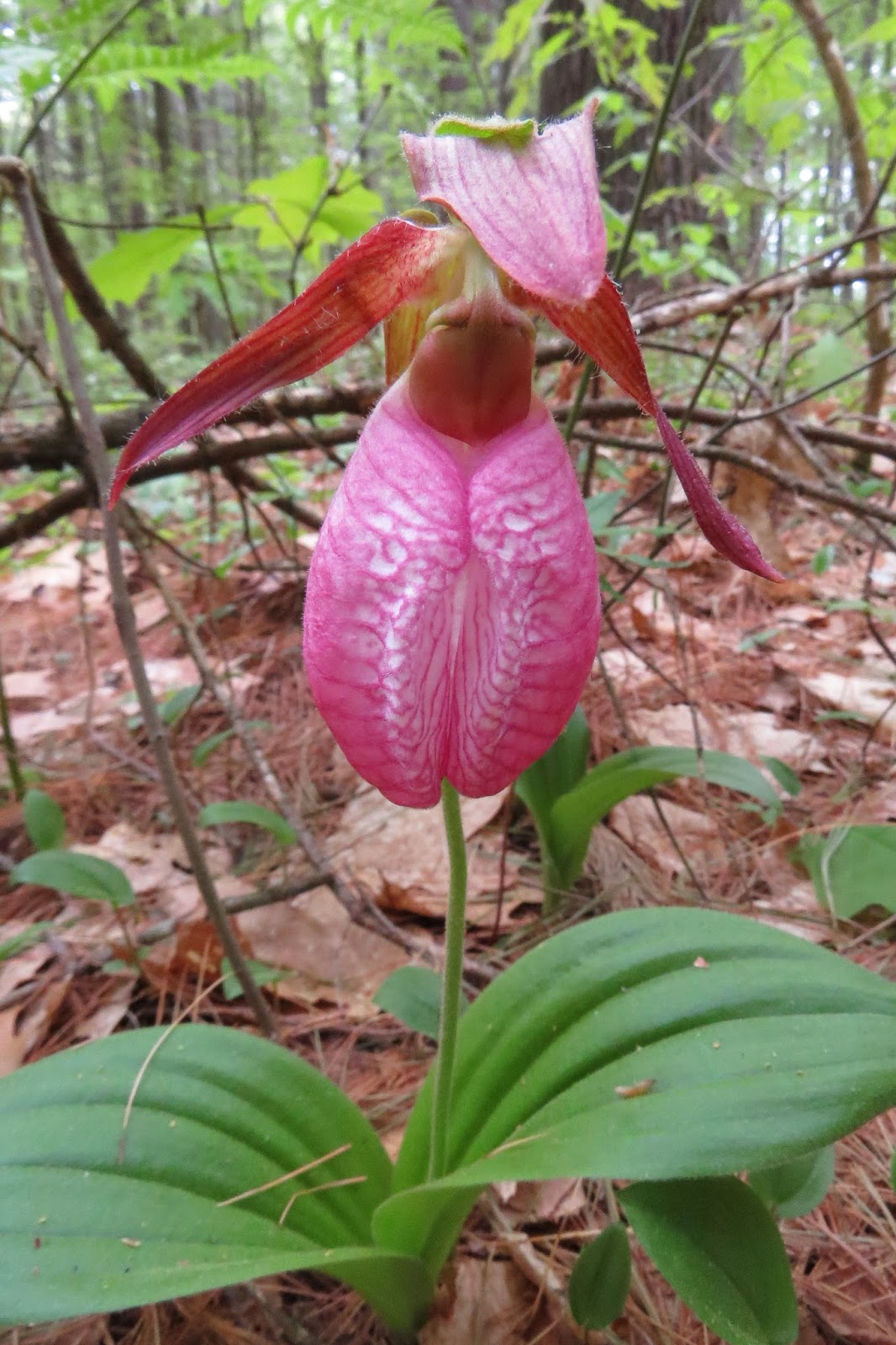
Lastly, it is blooming time for some of our more spectacular wildflowers, including the Pink Lady's Slipper, an orchid highly prized for its large single bloom. Keep your eyes peeled, and you just might see one, but please leave it there for a friend to find!
Nesting and egg-laying are in full swing around campus. Barn Swallows have constructed their cup of mud and pine needles under the Locke boathouse deck:
Red- Bellied Woodpeckers have taken up residence in a Red Maple snag at the east end of Bateman's:
Baltimore Orioles have strung up an intricately woven, sack-like nest above the road leading up to the tennis courts (just across the bridge).
Mid- May is the peak of songbird migration as well, so while our resident birds are settling in, dozens more species are moving through, leading to a peak in overall bird species diversity on campus. In just one hour on Sunday morning, over 50 species were found on the survey, most of which were heard only!
Middlesex School, Middlesex, US-MA May 17, 2015 6:09 AM
- 7:09 AM Protocol: Traveling 2.0 mile(s) Comments:
Sunday survey. Main drive, dock, and east fields. Orchard
Oriole new for MX campus list. <br />Submitted from BirdLog NA for iOS,
version 1.8 51 species
Canada Goose 4 Wood Duck 3 Great Blue
Heron 1 Virginia Rail 1 Mourning Dove 3 Yellow-billed
Cuckoo 2 Chimney Swift 6 Red-bellied
Woodpecker 2 Downy
Woodpecker 3 Hairy
Woodpecker 1 Northern Flicker
(Yellow-shafted) 1 Great Crested
Flycatcher 2 Eastern
Kingbird 2 Warbling Vireo
4 Red-eyed Vireo
5 Blue Jay 6 American Crow 1 Tree Swallow 2 Barn Swallow 4 Black-capped
Chickadee 5 Tufted
Titmouse 2 White-breasted
Nuthatch 3 Brown Creeper 1 Blue-gray
Gnatcatcher 3 Wood Thrush 4 American Robin
11 Gray Catbird 5 European
Starling 3 Cedar Waxwing 4 Ovenbird 3 Common
Yellowthroat 4 American
Redstart 2 Northern
Parula 2 Yellow Warbler
3 Pine Warbler 4 Canada Warbler
2 Chipping
Sparrow 8 Song Sparrow 1 Swamp Sparrow 1 Scarlet
Tanager 2 Northern
Cardinal 3 Rose-breasted
Grosbeak 4 Indigo Bunting
1 Red-winged
Blackbird 12 Common Grackle
16 Brown-headed
Cowbird 2 Orchard Oriole
1 RARE. New species for MX. Young male singing from
maples at pond edge near dock. Baltimore
Oriole 6 House Finch 4 American
Goldfinch 6 House Sparrow 3
The trail cameras captured a few mammals this week in the woods between the turf and the pond. I suspected there might be some activity around a large White Pine that sits on the edge of a skunk cabbage swamp, so one camera was aimed at its base. Unfortunately, the exposure settings were not quite right, and a branch waving just in front of the lens triggered about 400 extra exposures capturing nothing at all. A few rough gems still emerged, though, as I sifted through the pile of images. Nothing stunning or rare; just everyday life in Estabrook.
The Sunday bird survey crew (the few, the proud) met at 7:30 am sharp by the flagpole, ready to census the campus. Our route took us to the dock, down to the entrance road swamp, and back along the lower fields to the Chapel. Weather had not been favorable for north-bound migrants over the past couple of days, with winds out of the north and northwest, but we found some new arrivals nonetheless. A small mixed flock along the entrance road held Yellow-rumped and Palm Warblers as well as Ruby-crowned Kinglets and Blue-gray Gnatcatchers, none of which species were here in any numbers just last week. The highlight of the walk was probably the smashing view we had of a male Wood Duck near the dock. We failed to get photos, unfortunately, but a female did pose for a picture earlier in the morning as she inspected trees for potential nest cavities behind BP.
Along the way, we succeeded in getting this male Tufted Titmouse all riled up by imitating his whistled call, "Peter, Peter!" His mate was close by with nesting material in her bill, so he was feeling especially pugnacious. We left them alone quickly, though, as it is a waste of valuable time and energy for birds to be defending territory against phantom threats like us when they should be finding food, building nests, and warding off real challenges from actual titmouse neighbors.
The full species list from the survey follows.
Middlesex School, Middlesex, US-MA Apr 26, 2015 7:49 AM
- 9:30 AM Protocol: Traveling 1.0 mile(s) Comments:
Inaugural MIDDLESEX Earth Week Bird Walk. <br />Submitted from
BirdLog NA for iOS, version 1.8 33 species
Canada Goose 9 Wood Duck 3 American Black
Duck 1 Mallard 4 Great Blue
Heron 1 Turkey Vulture
4 Mourning Dove 2 Red-bellied
Woodpecker 1 Downy
Woodpecker 3 Hairy
Woodpecker 1 Eastern Phoebe
2 Blue Jay 6 Tree Swallow 10 Black-capped Chickadee
8 Tufted
Titmouse 1 White-breasted
Nuthatch 3 Blue-gray
Gnatcatcher 2 Ruby-crowned
Kinglet 1 American Robin
30 European
Starling 3 Palm Warbler
(Yellow) 3 Yellow-rumped
Warbler (Myrtle) 8 Chipping
Sparrow 10 Song Sparrow 1 White-throated
Sparrow 1 Dark-eyed
Junco 1 Northern
Cardinal 2 Red-winged
Blackbird 12 Common Grackle
20 Brown-headed
Cowbird 1 House Finch 1 American
Goldfinch 3 House Sparrow 5
When the birding was slow, we turned our attention to other organisms, like the snails of Bateman's Pond, which are easily visible this time of year before aquatic vegetation obscures the view in the shallows. The predominant large snail is most likely a non-native Asian species, the Chinese Mystery Snail (Cipangopaludina chinensis). These snails made their way to North America first as a food item in west-coast Chinese markets in the late nineteenth century, with the first documented record from Boston in 1914. So far, the Mystery Snail's negative ecological impacts appear minimal, though it likely competes with native gastropods.
Escargot, anyone?
An finally, on another note, the trail cams were placed in new locations last week, but there was very little activity detected; mostly brief fly-by birds and quick glimpses of squirrels. A small doe White-tailed Deer triggered the camera as she made a dawn pass along the trail at the east end of the pond, but let's hope that we have better luck in yet another new location.
The Bateman's bog behind Clay dorm and the library is hoppin'. Spring Peepers (Pseudacris crucifer) are in full song, and the evening chorus can be heard from almost anywhere on campus. If you want to go looking for them, though, you'll need boots, a flashlight, and, ideally, earplugs. The songs of individual males at close range (50 cm) may reach 92.4 decibels (to put this in context, a jackhammer at 50 feet away is in the 95 dB range). My ears are still ringing from shooting the video you see above! Given the enormous sound they produce, you may be surprised to find that Spring Peepers are actually quite small. Here is one in the hand of a relatively small twelve-year-old boy.
The primary purpose of the deafening chorus is, of course, reproductive, and therefore mating pairs are not an uncommon sight. Shown below, the male is the darker, smaller individual on top of the larger, paler female. As you can see from these images, there is considerable variation in individual coloration, with some peepers showing much more contrast in their skin pattern.
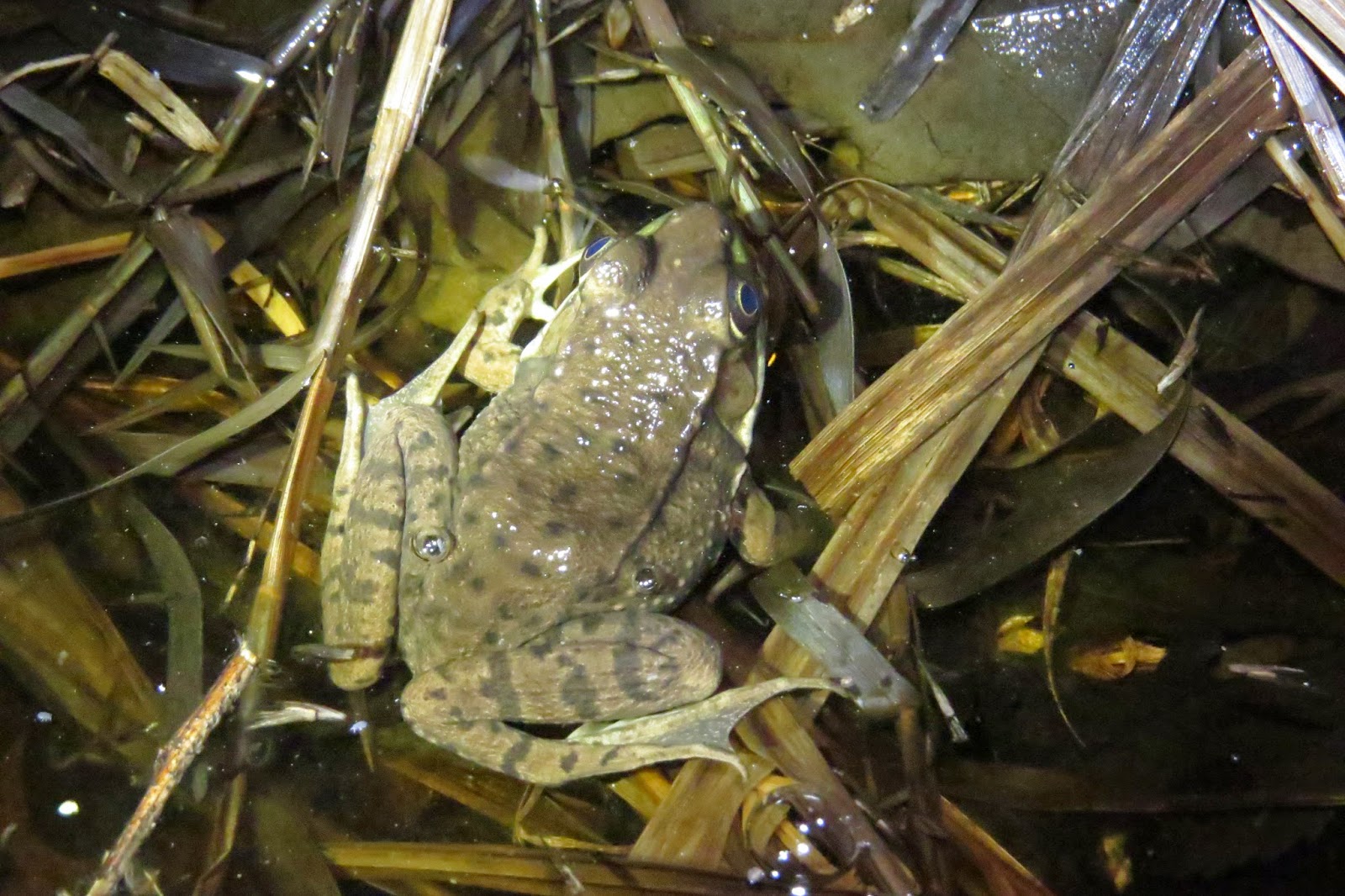
Peepers are not the only frogs active in the Bateman's bog these days, however. The rattling calls of Leopard Frogs can be heard alongside the short grunts of Green Frogs like this one: